 |
 |
 |


THE VET-FARRIER RELATIONSHIP
Optimizing the interaction between your farrier and your veterinarian for the good of your horse can be challenging.
This article highlights a few important points to consider when mitigating this relationship.
There is an old saying that goes something like this: “Good judgement comes from experience, and experience comes from bad judgement.” As equine performance practitioners, we at The Atlanta Equine Clinic have learned a few things about how to manage our relationship with farriers. Of course our education took many years and evolved at the expense of many farriers. We are fortunate to be associated with farriers that have “humored us” throughout our learning process.
The Vet-Farrier Flow of Info
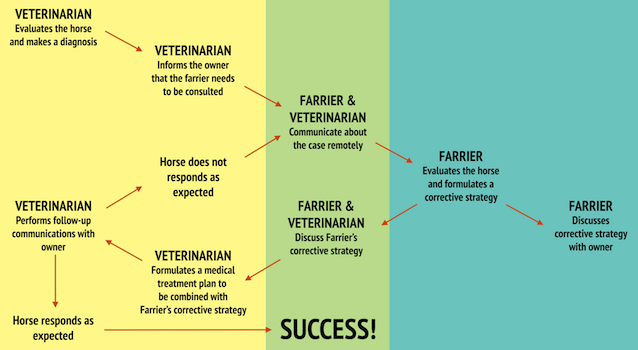
Important Points to Remember*
• As veterinarians, we should speak to the farrier about trimming/ shoeing the horse’s foot… not the horse owner. By dispensing information to the horse owner, we put he or she in a position to not only interpret out theories but also to relay them to the farrier. Putting clients in a position to have to digest and relay information between parties is not fair and often not effective.
• Speak about the concepts that we would like to implement, not the shoeing package(s). Every farrier, like every vet, has a preferred way of doing things. We seem to be much more successful when we don’t try to dictate specific shoeing techniques to the farrier.
• Provide the farrier with a diagnosis first, then discuss treatment options. Our job as veterinarians is to provide the diagnosis and present the case as accurately as possible, then to allow the farrier to do his or her job.
• Meet the farrier (in person) at the barn whenever possible. Putting clients in a position to translate opinions can be the start of problems. We can circumvent this by both being in the presence of the horse at the same time.
• Use diagnostic imaging (particularly radiographic images) whenever possible to make a point. It helps to let diagnostic images (especially radiographic images) run the show as much as possible. It also streamlines the dialogue between the vet and farrier, as both parties chave access to the same images.
• Take time to understand the farrier’s concerns about each horse and its respective foot care. As horse owners and veterinarians, we are usually better off listening to the farrier’s opinion and letting he or she drive the ship with respect to our eventual trimming/ shoeing strategy.
• Consult with farrier(s) as often as possible. Current technology allows us to communicate instantly and from anywhere at anytime. New telemedical platforms make it easy to connect with each other as often as we want, while also providing an environment for rich discussion and secure management of videos, photos, x-rays and commentary. The more often we talk, the better the service we provide to the horse.
• Provide the farrier with very detailed notes/ recommendations that clearly highlight my concerns about the horse. The farrier can take or leave what they want, but it’s up to the veterinarian to be clear and detailed description of what it is that he or she wants. Some vets spend too little time explaining their opinions and too much time blaming the farrier for misinterpretation.
• Always allow the farrier to take or leave our opinion(s). As veterinarians, we should have the freedom to provide input with respect to the horse’s trimming or shoeing package. However, we also need to provide the farrier with the freedom to perform his or her job the way that he or she sees fit.
• Provide written shoeing prescriptions ONLY if requested by the farrier. We have found that unsolicited prescriptions can often discourage productive dialogue with the farrier, especially if the horse owner is is in the position to interpret the prescription or see to its implementation.
• Don’t charge the client to consult with the farrier. Charging for this service gives the farrier the impression that the vet is literally “working” to have a relationship with them.
• Take the blame for anything about the horse’s corrective package that doesn’t work or that the owner doesn’t like. Veterinarians need to be ready to take the blame, especially if the farrier goes with their recommendation. The veterinarian’s strategy might not work or the vet may not have been explicit enough in his/ her explanation to the farrier. In both these cases, it’s the veterinarian’s fault.
• Give the credit to the farrier whenever something goes RIGHT. In reality, the farrier frequently does more to fix the horse than the veterinarian does, at least for the long-term.
• Take care and be cautious when working around a horse’s foot (for instance when pulling a shoe). It is important for veterinarians and horse owners to respect the work that farriers do as well as the tissue upon which they do it.
• When recommending a farrier to a client, recommend at least three individuals in the area. We have found it better not to appear as though we are associating our practice with only a select few farriers. This action portrays favoritisim, which subsequently promotes compromised relationships.
• Go out of our way to be available to the farrier as needed. The farrier's job is hard enough… the least that we can do is help when appropriate.
• Don’t forget to say “THANKS!”
*This information was presented as part of a lecture entitled “A Case Study For Successful Veterinarian And Farrier Teamwork” presented by Tim Shannon CJF AWCF APF and Bob Grisel DVM at the 16th Annual International Hoof Care Summit in Cincinnati, Ohio (2019).